Summarize this page with
Fit proxy detection into an action deadline by measuring collection, transport and result availability separately. Cache only the result type that is safe to reuse, retain its original timestamp and distinguish timeout from a negative classification. A fast cache hit is useful only when the evidence is still relevant.
A signup page waiting on an IP lookup and a browser-assisted check completed before submission have different timing paths. Measure what the user actually waits for, rather than comparing one vendor’s server response with another product’s entire collection process.
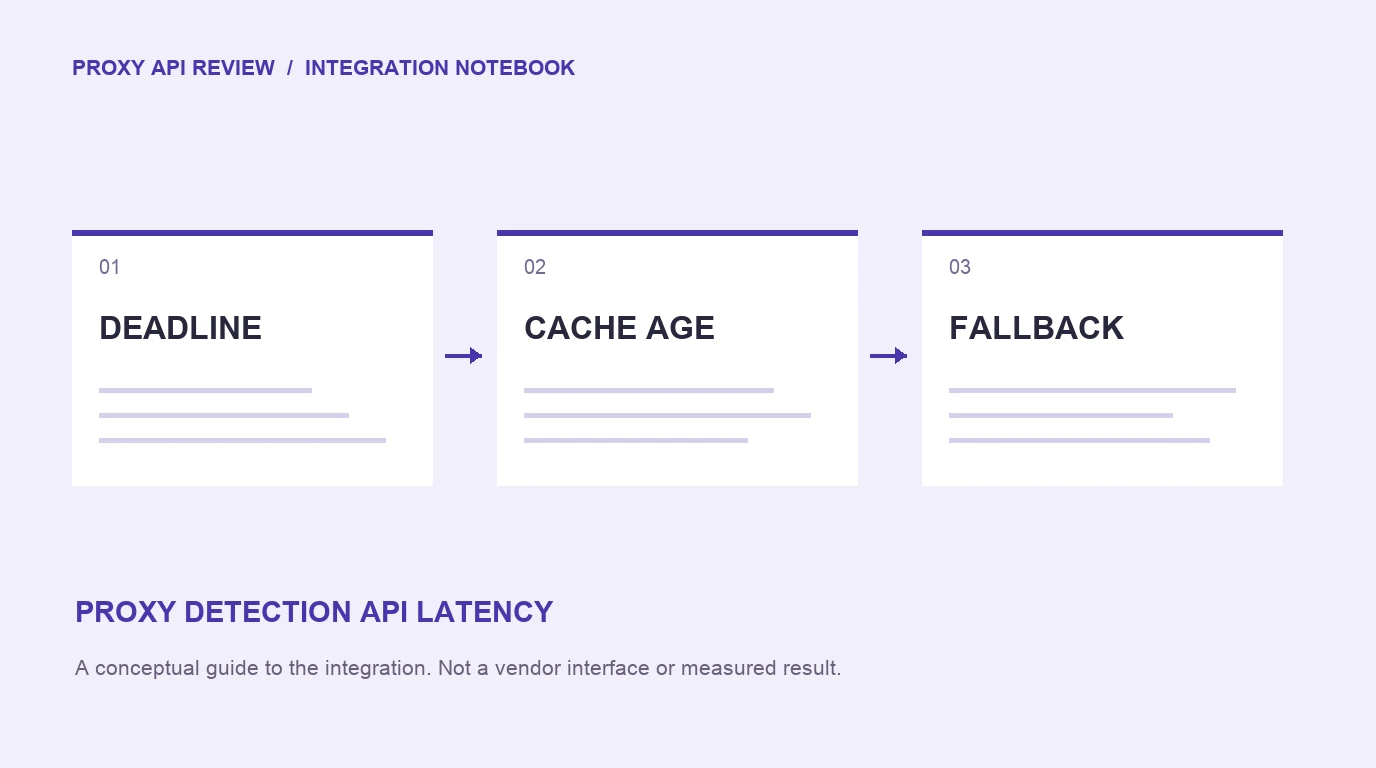
- 1Set an event deadline
- 2Cache the right object
- 3Record failures and freshness
Define the event deadline
Write down when the application must decide: before accepting a signup, issuing a session or completing another protected action. Identify which steps can begin earlier and which require information available only at submission.
Record collection start and completion, request start, result receipt and the final action time. Use percentiles from a representative region and workload, including cold connections and bursts. A median alone hides the slow tail that users encounter.
The deadline should be enforceable in the application’s execution environment. A socket timeout can limit one operation without acting as a complete wall-clock limit across name resolution, connection establishment, reads and retries. The Python example deliberately identifies that boundary.
Choose the cache object before its lifetime
| Object | Potential reuse | Boundary to preserve |
|---|---|---|
| IP-only network result | Same address, product, version and request options | Freshness, license and provider cache guidance |
| Local database lookup | Same downloaded edition | Dataset build date and update process |
| Browser observation | The documented event or supported session scope | Current device, time and collection completion |
| Account-risk assessment | The intended account/action under product rules | Application identity and event relevance |
Do not store a visitor or account result under only an IP key. Shared corporate and carrier networks can contain unrelated customers. That cache would transfer one person’s risk context to another.
For an IP cache, include the provider, product/version and meaningful request options. An assessment obtained at one strictness setting may not be equivalent to another. Retain checked_at, expires_at and any observation timestamp separately.
Make expiration explicit
A time-to-live balances latency and freshness. Its value depends on the product, license, network behavior and action risk; this article does not prescribe one universal duration. Follow the provider’s published guidance and evaluate rotation in your permitted traffic.
A stale result must not acquire a fresh observation time simply because it was read from a cache. Keep the original timestamp. If the application deliberately permits stale data during an outage, record that decision and the age it accepted.
Residential exits and reassigned addresses make expiration particularly relevant. Repeat checks in the controlled residential-proxy test, including any cache layer used in production. Otherwise the pilot can accidentally test the application cache rather than the provider.
Treat rate limits as an operational state
HTTP 429 indicates that the request was rate limited. Inspect any documented retry information and the provider’s policy. Authentication failures, exhausted allowance, malformed requests and transport failures need their own operational classification as well.
A retry can consume time and quota. Cap retries, avoid synchronized retry storms and stop when the action deadline no longer allows a useful result. A later background retry may support investigation without satisfying the original request-path requirement.
Daily quotas also make burst shape matter. A service can fit its average monthly budget yet exhaust a daily allowance during a campaign. Review actual billing units using the free API and cost guide, including how batches and retries are counted.
Specify unavailable-result behavior
There is no universal fail-open or fail-closed policy for every action. Decide what happens when a usable result does not arrive: continue with other evidence, require verification, defer a benefit or send an action for review. Record the chosen path and business reason.
The operational state must remain visible whichever policy is used. “Allowed because the detector found no proxy” and “allowed because no result arrived before the deadline” are different records. That distinction is necessary when evaluating both customer friction and protection coverage.
ShieldLabs and other browser-assisted integrations should be assessed through their supported collection and backend delivery. An installed snippet, a received callback and a result available before action time are separate checkpoints. The JavaScript guide explains action binding.
Measure the path you intend to deploy
Collect a small set of useful operational metrics: attempted checks, completed results, cache-hit age, timeouts, denied calls, contract errors and deadline misses. Break them down by route, application region and provider product where appropriate.
For a local database, test update failure and an old edition alongside normal lookup speed. For API delivery, test unavailable service and exhausted test allowances in an approved environment. For a browser flow, test interrupted navigation and missing collection.
Compare timing and freshness together. A cached negative can be fast and stale; an accurate late result can be unusable for the original action. The right integration meets the action deadline with evidence the application can interpret and recover from.
FAQ
Should every proxy result be cached by IP?
No. An IP-only network result may be reused within its scope and freshness policy. Visitor, device and account assessments need their own documented identity and event boundaries.
Does an HTTP timeout mean the address is safe?
No. It means no usable result was obtained within the relevant operation or deadline. Preserve an unavailable state and apply explicit application behavior.
Should a local database always win on latency?
A local lookup avoids an external round trip, but it has different evidence, refresh and operational requirements. Compare the required fields and dataset freshness alongside timing rather than selecting on lookup speed alone.
Sources
- MDN HTTP 429, rate-limit semantics.
- proxycheck.io API documentation, response versions, limits and caching guidance.
- Python urllib.request, timeout behavior.
- MaxMind developer documentation, downloadable data product scope.
Continue reading
- What is a proxy detection API? Methods and outputs
- Proxy detection in JavaScript: browser and backend
Compare all ten tools or read the complete deployment guide.