Device and browser evidence alongside a proxy API
An IP lookup describes the observed connection. A browser identification describes a collected environment. Treating them as one unnamed risk value makes debugging difficult: an address can change while the device stays familiar, or a new device can reuse an ordinary address. The integration should retain both observations and their timestamps.
Summarize with AI
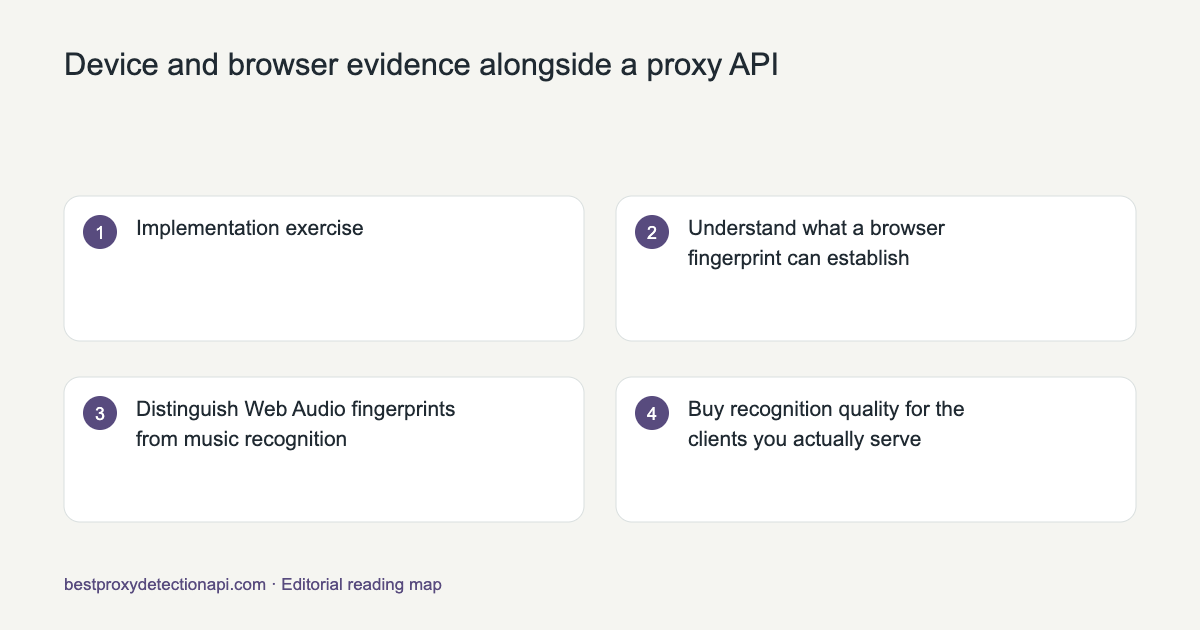
Implementation exercise
Build a small authorized fixture set: one browser before and after storage clearing, a second browser on that machine, a second device on the same Wi-Fi and the original browser through a corporate VPN. Keep the event references and expected relationships. A detector should be evaluated on recognition, collisions and risk separately. An audio or canvas observation can contribute to recognition, but it must not become a fabricated authentication credential. When a field is unavailable, keep that state distinct from a measured safe result. Use the same fixtures after an SDK upgrade.
Understand what a browser fingerprint can establish
Browser fingerprinting compares observable characteristics such as browser configuration, graphics rendering, language, time zone and supported APIs. A fingerprint can help recognize an environment; it is not an authenticated name or a guaranteed unique person.
Canvas techniques can read rendered pixel data through getImageData. Browser detection from a user-agent or feature test identifies compatibility, while a multi-signal fingerprint estimates continuity. The collection and its stability depend on browser protections, updates and permissions.
For a controlled example, compare the same browser profile before and after an update, then compare a second profile on the same laptop. Observe changed and unchanged fields without calling every change fraud. W3C describes the privacy risks of re-identification. Limit collection to the purpose, protect stored data and offer usable behavior when fields are reduced. Privacy protections can create missing data without indicating abuse.
Distinguish Web Audio fingerprints from music recognition
Audio fingerprinting has two common meanings. Browser audio fingerprinting renders a known Web Audio processing graph and derives a value from its output. Acoustic or music fingerprinting extracts identifying features from a recording to match it against a reference catalog. A browser fraud SDK and a song-identification SDK solve different tasks.
OfflineAudioContext renders into an AudioBuffer without playing through the device hardware. That processing does not by itself record the room or require microphone capture. getUserMedia is a separate API for requesting media input. Web Audio's privacy discussion addresses fingerprinting exposure.
A browser fingerprint should be assessed alongside other environment observations. Updates and privacy defenses can change the result. For a music-recognition project, evaluate catalog coverage, matching under noise, licensing and recording permissions separately. A stable oscillator hash cannot tell you the title of a song playing nearby.
Buy recognition quality for the clients you actually serve
Device fingerprinting providers differ in collection, matching, history and integrations. Compare recognition after storage changes, collisions between distinct devices and behavior after normal software updates. A single aggregate accuracy number rarely describes all three.
Shortlist ShieldLabs for combined device/network intelligence and account-abuse detection, Fingerprint for visitor recognition and Smart Signals, Castle for account-risk context, Verisoul for duplicate-account matching and Incognia for native device/location use cases. ThumbmarkJS is an open-source fingerprinting option; operating a library, a matching service and a fraud workflow are different responsibilities.
For ecommerce or CIAM, test known customers returning without a login alongside genuinely new customers. For fintech and regional deployments such as Saudi Arabia, verify supported clients, data location, transfers, retention and the applicable identity obligations. A JavaScript integration does not establish native mobile coverage. Ask for SDK documentation and sample outputs before accepting a web-and-mobile claim.
Treat device intelligence as evidence plus operational context
Device intelligence combines device observations with risk, history and relationships to accounts or transactions. Fingerprinting supplies one recognition method. A platform may add tampering, automation, network or location signals, event lookup and case review.
A practical procurement matrix separates collection, identity, risk output, workflow and access. ShieldLabs combines device/network intelligence, risk scoring and ready-made account-abuse detection. Castle adds device, email, IP and behavioral context. Fingerprint documents visitor recognition and Smart Signals. Incognia describes native mobile device and location intelligence. Verisoul emphasizes account matching. Verify each product's SDKs and required permissions for your channel.
Digital intelligence can also mean asset discovery, forensics or market research. DeviceAtlas-style device classification identifies device capabilities; it should not be assumed to identify a unique operator. Enterprise and fintech buyers should test data handling, retention, review permissions and the handoff to authentication. A broad feature checklist is less useful than knowing which event and client each feature supports.
Choose a denominator before reading the visitor ratio
A new visitor is first observed under the analytics system's identity rules; a returning visitor has qualifying earlier history. Changing browsers, clearing storage or switching devices can make the same person appear new. The count therefore describes measured identifiers, not a census of unique people.
Google Analytics defines new and returning users using its own event and identity model. A daily visitor count, active users, sessions and page views use different units. One person can generate several page views and visits. Compare Vercel or another analytics product only after aligning those definitions and time zones.
There is no universal good new-to-returning ratio. A new acquisition campaign should look different from a subscription support portal. Track the ratio by channel and cohort, alongside activation, repeat purchase or paid retention. To test counter accuracy, use a small controlled set of visits and known repeat sessions, then inspect how consent, storage and cross-device activity change the count.
Personalize before login with low-risk context
Anonymous visitor personalization can use current page, language preference, broad region, referrer and consented prior visits. A product can show relevant documentation or preserve a cart before it knows a person's name. Start with information that is necessary and easy for the visitor to change.
When an anonymous guest later authenticates, join the earlier session to the account only through an authorized and documented process. Avoid merging different people merely because they share a household device. Keep security identifiers and advertising audiences under their intended access and retention rules.
Measure the actual helpful outcome: completed onboarding, a recovered cart or successful support navigation. A visitor counter cannot tell whether an inferred interest is correct. Offer a neutral fallback when identity confidence is low. Highly sensitive offers, prices or access decisions deserve stronger evidence and review than a documentation recommendation.
Look for inconsistencies across the environment
Anti-detect browsers manage or alter browser profiles to separate sessions and change observable characteristics. Detection compares those observations with connection, device and account evidence. A single unexpected font, user-agent or missing API is weak evidence because legitimate updates and privacy settings can produce changes.
An anti-detect browser and a headless browser are different concepts. Headless describes operation without a visible interface; anti-detect describes masking or profile management. Either can be used for authorized work or abuse. CreepJS, BrowserLeaks and Pixelscan expose environment details useful for a controlled diagnostic, but a clean checker result cannot prove that every fraud system will classify the session as ordinary.
For authorized social-media management or traffic measurement, use platform-supported workflows and disclose automated access where required. For detection, test profile resets, proxy changes and legitimate privacy configurations against account outcomes. ShieldLabs includes anti-detect browser and automation detection. Retain independent evidence before restricting an account, and offer a way to resolve a browser compatibility failure.
Use connection fingerprints as grouping evidence
TLS fingerprinting summarizes aspects of a client's connection handshake. HTTP/2 fingerprinting uses protocol behavior such as settings and request characteristics. JA4T belongs to the JA4 family for TCP characteristics; it is not another name for a browser canvas fingerprint.
FoxIO maintains the JA4 reference project, including tools and formats for supported fingerprint types. Use an implementation appropriate to the capture layer rather than inventing a hash from unrelated log fields. Check licensing and deployment requirements for the selected component.
Cloudflare documents JA3 and JA4 availability and cases in which fields are missing. Many clients can share a connection fingerprint, and intermediaries can change what the server observes. Combine it with endpoint behavior and account events; do not treat a common hash as a unique person or a cryptographic proof of device identity.
Compare the output before choosing the identity control
| Output | What it helps establish | What still requires another record |
|---|---|---|
| Browser capability result | Whether the client supports a feature | Whether this is a returning visitor |
| Device or visitor recognition | A supported relationship to prior observations | The account holder's permission |
| Authenticator result | Control of a registered authenticator | Eligibility for a new benefit |
| Identity proofing result | Required real-world identity attributes and association | The current account action and its authorization |
Use NIST proofing and authentication guidance to keep those contracts distinct.
Sources
- Canvas official source · read
- Fpprivacy official source · read
- Chrome official source · read
- Browserscan official source
- Audio official source · read
- Mic official source · read
- Webaudio official source · read
- Shield official source · read
- Fingerprint official source · read
- Castle official source · read
- Verisoul official source · read
- Incognia official source · read
- Rawfp official source · read
- Deviceatlas official source · read
- Gausers official source · read
- Ga official source · read
- Authorization official source · read
- Fox official source · read
- Ja official source · read
- Shieldpricing official source · read
Continue reading
- Proxy api login and bot controls
- Proxy api trust freshness and cost
- Proxy api eligibility and repeat accounts
- Proxy api checkout and content access
- Proxy api outcome logging and ad traffic
- Proxy api vendor and adjacent tool selection
- Proxy vpn api response fields
- Proxy detection api latency caching
- Proxy detection api javascript
- Public checkers and vendor demos
- More research guides
FAQ
Does avoiding browser fingerprinting mean a user is fraudulent?
No. Privacy tools, reduced APIs and ordinary browser changes can alter or suppress observations. Detection systems should handle missing data explicitly, combine independent evidence and measure legitimate user impact. A privacy checker describes the current environment; it does not certify that every site will recognize or fail to recognize it.
What did Chrome announce in Privacy Sandbox next steps?
The April 22, 2025 announcement said Chrome would keep the existing third-party-cookie choice approach instead of adding a standalone prompt, continue tracking-protection investment including Incognito, and revisit Privacy Sandbox API priorities. Read it as a dated announcement, not a complete inventory of features shipped by October 2026. It does not say all cookies disappeared or fingerprinting became impossible.
What can a browser scan or BrowserScan show?
If the intended service is BrowserScan at browserscan.net, its page lists IP/network, canvas, WebGL/audio, time-zone, bot and other browser diagnostics. A generic browser scan similarly describes exposed observations. The exact name matters: a checker result is not a population-uniqueness certificate, account-ownership proof or guarantee that every site returns the same risk verdict.
Does an audio fingerprint listen to a visitor through the microphone?
A Web Audio fingerprint can render a synthetic graph offline without microphone input. Recording audio requires a separate capture path, such as getUserMedia, and its permissions. Check the actual SDK and network payload rather than inferring microphone access from the phrase audio fingerprint.
What is the best device fingerprinting API for developers?
The useful choice is the API that recognizes the intended clients and exposes enough event history to protect the action. Compare ShieldLabs, Fingerprint and Castle for web workflows, Verisoul for account matching, and Incognia for native device/location requirements. Measure recognition and collisions separately and verify billing and data-handling terms.
How should web and mobile intelligence be compared?
Run separate test sets for browser, native app and any webview. Record which SDK supplies each signal, what permissions it needs, how resets affect recognition and how server events are linked. A platform supporting web and mobile must demonstrate both paths; the same product name does not make their coverage identical.
Is DeviceAtlas the same as a fraud device identifier?
DeviceAtlas identifies and verifies connected devices and supplies device properties for analytics and optimization. Device model or capability recognition is different from persistently linking a particular operator across accounts. Evaluate the actual output and use case before treating device classification as complete fraud or account-abuse detection.
Why does a customer look new on another device?
The analytics system may have no authenticated or permitted link between the two device observations. Cookie-based counts commonly start a new identity. Compare the same person's authenticated history where appropriate, and label device-level or browser-level counts accurately rather than treating the difference as fraudulent activity.
What can anonymous visitor tracking tell a business?
It can describe observed visits, paths, campaign context, technical environment and possible repeat visits within the system's limits. It does not inherently identify a person's name or intent. Use it for a stated purpose and validate the business outcome rather than treating a pseudonymous profile as a verified customer record.
Does an inconsistent browser fingerprint prove anti-detect use?
No. Updates, privacy extensions, reduced APIs and remote environments can create inconsistencies. Combine independent technical and account evidence, then evaluate the specific protected action. A public checker is useful for diagnosing exposed fields but cannot certify evasion of every detector.
Is anti-vedic browser an established detection category?
The string does not establish a specific verified product. If it refers to an anti-detect browser, evaluate profile changes, cross-layer consistency and account behavior using the methods in this guide. Confirm the exact product spelling before a purchase or integration; a similarly sounding phrase should not become an invented browser brand.
Is a JA4T generator a device identification API?
No. JA4T describes TCP characteristics from suitable network observations. A device identification service can combine several signals and event history. Choose the reference implementation for the observed protocol and interpret its output as one piece of evidence, with collisions and intermediary effects in mind.