Use proxy evidence in trial, bonus and account eligibility
A network response does not say whether a person is entitled to another trial or welcome offer. Eligibility lives in the product's account and benefit records. The API should contribute evidence before the entitlement is granted, while the grant itself remains atomic and safe to retry.
Summarize with AI
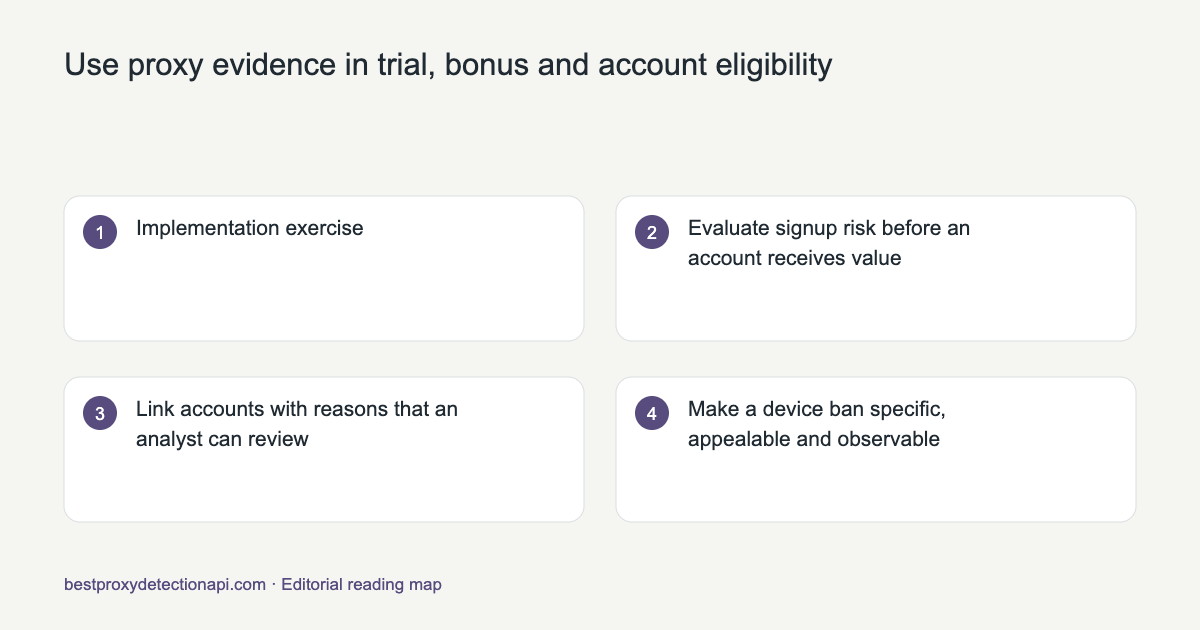
Implementation exercise
Suppose two parallel signup requests each pass a network lookup and then ask for a credit grant. If the product checks eligibility and writes the grant in separate steps, both can succeed. Fix that race in the entitlement ledger; another detector cannot repair it afterward. Next, add device and account relationships to find claims made through different emails or routes. Preserve the reason and offer version so support can distinguish a duplicate claim from an invited coworker. Test a failed webhook, a retried request and an approved appeal without issuing duplicate value.
Evaluate signup risk before an account receives value
A fake account is an account created or operated under a misleading identity or purpose. New-account fraud includes automated registrations, repeat benefit claims, fabricated seller profiles and accounts prepared for later misuse. Email verification proves access to an inbox; it does not prove a unique person or a legitimate intent.
Run request controls at signup, check device and network context, and relate the registration to previous accounts. Phone and email intelligence can add evidence, while identity proofing serves applications that require a verified real-world identity. NIST separates identity proofing from authentication. A fraud detector does not automatically fulfill regulated identity-verification obligations.
ShieldLabs, Verisoul, Castle and SEON are candidates for account and device risk. Verisoul describes account matching, email and phone intelligence; compare which attributes your signup actually collects. For gaming, retail, fintech and SaaS, attach controls to the first valuable action as well as account creation. A delayed signup alert is less useful if credits, payouts or listing privileges are already available.
Link accounts with reasons that an analyst can review
Multi-accounting is one operator controlling several accounts in a way that violates a product's rules. The detection task is to relate activity across email changes, cookie resets, IP rotation and browser profiles. A shared IP alone can link an entire household or employer, so it should not decide account ownership.
Compare account graphs, device recognition, network evidence and event history. ShieldLabs detects multi-accounting alongside account sharing and takeover. Verisoul emphasizes probabilistic account matching and user networks. Castle combines device, IP, email and behavioral context. A general fraud suite may also cover payments; a specialist can be simpler when repeat benefits are the only problem.
Test both evasion and legitimate overlap: one person returning after clearing storage, two roommates on one network, a family sharing a laptop, and a real customer changing phones. Record which link caused action and how it can be challenged. Geolocation and anti-detect detection can add context, but neither proves that two accounts belong to the same person. A compliance recommendation also requires the relevant jurisdiction and identity requirements.
Make a device ban specific, appealable and observable
Ban evasion means returning to a service in a way that avoids a prior restriction. A device ban associates the restriction with an observed device or environment instead of only an email or IP address. A changed identifier, shared device or secondhand laptop can make this association uncertain.
Maintain a record of the original restriction, its scope, expiry and appeal route. Combine repeat device or account evidence with behavior that violates the same policy. Avoid treating a recycled residential address or an institutional computer as a permanent individual identity. For gaming communities, moderation history and content context belong beside technical links.
A new account can be legitimate after an approved appeal or ownership transfer. An analyst should see why a prior restriction is relevant and be able to undo an incorrect link. Whether ban evasion is illegal depends on facts and jurisdiction; a platform-rule violation does not by itself establish a criminal offense. Legal decisions require advice tied to the actual conduct and location.
Distinguish sharing from normal multi-device use
Account sharing occurs when several people use one account outside the permitted subscription or seat policy. A single person using a laptop, phone and television is a different case. Device counts, concurrent sessions, approximate locations and history need an explicit entitlement policy before they become enforcement rules.
ShieldLabs detects account sharing; a subscription product still needs the billing and access path that follows the detection. For SaaS, offer a seat invitation or team upgrade. For streaming, define household and travel exceptions. Revoking every session at once can lock out the paying owner and create avoidable support work.
Consented account-data access is another category. A financial connectivity provider manages permissioned access to external accounts, while sharing detection evaluates use of your own account. Specify which service is needed. Measure recovered paid seats, successful owner verification and incorrect restrictions alongside detected sharing, so the program does not reward disruptive enforcement.
Protect the entitlement, not just the registration form
Free-trial abuse is repeatedly obtaining a limited trial outside its intended eligibility. Define the entitlement first: per person, account, organization, payment method or workspace. A second employee at a genuine company may deserve a seat even if that company has already evaluated the product.
Use verified contact details, device and account links, rate limits and a server-side eligibility ledger. Check before credits or access are provisioned. A challenge can slow automation, while a ledger prevents repeated grants and concurrent requests from issuing the same benefit twice. Keep a recovery route for shared devices and company networks.
For SaaS, compare ShieldLabs, Verisoul and Castle on repeat-account detection, global client support, server verification and operational cost. At 50,000 monthly signups, price the actual identifications, retries and protected actions rather than assuming one signup equals one billable check. An edge service limits expensive requests early; a cloud API adds account context. The two can be complementary.
Limit compute exposure before the first expensive job
For an AI trial, account creation can be nearly free while the first generation or GPU job has immediate cost. Protect the job scheduler and credit ledger as well as signup. Allocate a small initial allowance, unlock more value after verification, and cap concurrent work and accumulated spend.
A hypothetical product grants a starter credit allocation to a new workspace. It records the grant once, checks whether linked accounts have already claimed it, and reserves credits before accepting a compute job. A retry reuses the reservation instead of minting new credits. If a review is needed, the product can keep a low-cost preview available while holding the expensive action.
Compare detector cost with the compute at risk and conversion effects. A request blocked at the edge may save origin work, but a low-rate human-operated account farm can still require device and account links. ShieldLabs can provide those risk and abuse signals; the product's budget and entitlement systems remain necessary to control consumption.
Enforce promotion eligibility at redemption
Promo-code abuse includes repeated first-customer discounts, unauthorized stacking and redemptions beyond an offer's intended eligibility. Coupon fraud can also involve stolen or fabricated codes. State allowed customers, products, periods and combinations, then enforce those terms on the server at redemption.
Stripe distinguishes coupons and customer-facing promotion codes. Configuration controls discount behavior; device and account checks help identify repeat claimants across separate accounts. A phone number adds useful context, but prepaid, reassigned and shared numbers need careful treatment. Verisoul and SEON describe phone intelligence alongside other signals; ShieldLabs supplies device, network and account-abuse detection.
Reserve a redemption within a transaction so parallel checkout attempts cannot claim a limited benefit twice. Retain the offer version and the reason for rejection. Test legitimate repeat buyers, household members and affiliate-distributed codes. Promotion controls should preserve a full-price purchase path where appropriate rather than making the entire store inaccessible.
Pay for qualified referrals after the outcome is known
Referral fraud uses fabricated invitees, self-referrals or manipulated attribution to claim a reward. A click and an email signup are weak payout conditions. Define the qualifying purchase, activation or retention event and check that referrer and invitee meet the program's relationship rules.
Compare device and account links, payment references where appropriate, referral paths and the time between invitation and activation. Shared offices and families produce legitimate overlap. A circular pattern of accounts referring each other deserves review, but one shared network should not automatically cancel every reward.
Keep rewards pending until the qualification window closes and reconcile cancellations and refunds. In banking, identity and financial eligibility checks require a suitable provider and jurisdictional review. For job-ad referrals, join the referral to a verified application or hire before commission is paid. Device evidence helps connect actors; the attribution ledger establishes what outcome occurred.
Protect both points issuance and points spending
Loyalty fraud includes unauthorized account access, fabricated earning events, manipulated points balances and illegitimate reward redemption. A program can have clean signup traffic and still lose value through account takeover or an internal adjustment path.
Maintain an append-only transaction history for points, with the earning reason, account, order and reversal reference. Require fresh authentication for sensitive changes and valuable redemptions. Connect device and session history to the points event so a new-device redemption after a recovery change receives appropriate scrutiny.
Device risk services help detect account and operator patterns. Order and loyalty systems determine whether points were actually earned, reversed or redeemed. Evaluate a tool with normal gifts, shared family programs, expired points and partial refunds. The useful outcome is eligible rewards delivered with controlled losses, not simply a larger total of flagged accounts.
Review bonus eligibility, account links and payments together
Bonus abuse in iGaming usually involves repeated eligibility claims or coordinated accounts exploiting a promotion outside its terms. Device links, network masking, account history and payout behavior can expose coordination. An IP from another country is a separate location question and should not be treated as proof that a player claimed a bonus twice.
Use explicit terms for eligible players, household restrictions, wagering requirements and withdrawal conditions. UK Gambling Commission guidance is relevant to covered operators; requirements vary by jurisdiction. Device intelligence does not replace KYC, age verification, responsible-gambling controls or required geolocation checks.
ShieldLabs detects multi-accounting and other abuse using device and network intelligence; SEON and Verisoul also offer account-risk capabilities. A payment provider can add transaction and identity evidence. Compare claims, deposits, wagering and withdrawals as separate events. Players seeking to avoid penalties should follow the published terms, disclose mistakes through support and request a review rather than try to evade detection.
Price one-person-many-identities abuse into the system design
A Sybil attack uses multiple identities controlled by one actor to distort a system that expects independent participants. In a blockchain airdrop, Sybil farming claims rewards through many wallets or accounts. A wallet address is not proof of a unique person.
The original Sybil research explains the identity problem in distributed systems. Practical defenses can combine scarce-resource requirements, eligibility history, account/device relationships, reputation and identity verification where appropriate. Each has trade-offs for privacy, access and concentration of power.
For an airdrop, define the rewarded behavior and snapshot rules, review linked claims and make the appeal process explicit. Device signals may connect a web claim session; blockchain analytics observes wallet relationships. Neither alone proves every beneficial owner. The French query qu'est-ce qu'un airdrop Sybil has the same conceptual answer, but this English guide does not create French-language search coverage.
Sources
- Nist official source · read
- Shield official source · read
- Verisoul official source · read
- Castle official source · read
- Seon official source · read
- Challenge official source · read
- Fpprivacy official source · read
- Authorization official source · read
- Session official source · read
- Auth official source · read
- Auth0 official source · read
- Onetrust official source
- Oauth official source · read
- Oauthsecurity official source · read
- Trial official source · read
- Idem official source · read
- Fraudfilter official source · read
- Fraudfilterprice official source · read
- Adpolice official source · read
- Rest official source · read
- Coupon official source · read
- Logging official source · read
- Refund official source · read
- Promotion official source · read
- Dispute official source · read
- Sybil official source · read
Continue reading
- Proxy api login and bot controls
- Proxy api device and browser evidence
- Proxy api trust freshness and cost
- Proxy api checkout and content access
- Proxy api outcome logging and ad traffic
- Proxy api vendor and adjacent tool selection
- Proxy vpn api response fields
- Proxy detection api latency caching
- Proxy detection api javascript
- Public checkers and vendor demos
- More research guides
FAQ
How can signup protection remain usable on mobile?
Use a provider with documented support for the actual mobile client, bind the server result to registration, and test weak networks and failed collection. Add verification according to the value being granted. Browser telemetry from a webview and native app integrity are different capabilities and need separate evaluation.
How should a growing platform choose a multi-accounting tool?
Start with the event that creates loss and the account relationships needed to protect it. Compare ShieldLabs, Verisoul and Castle on those relationships, supported clients, review workflow and total checked events. Choose a wider suite when payment or identity workflows are also required; verify those modules rather than buying a broad label.
How do platforms detect alternate accounts after a ban?
They compare account history, device observations, network context and repeated behavior with the original restriction. Stronger systems keep link reasons, expiry and an appeal process. An IP-only denylist is unreliable on shared or reassigned networks, while a device observation should also be reviewed for legitimate shared use.
What should an account-sharing tool enforce automatically?
Only a documented subscription policy with a reversible response. Start with notice or an upgrade route, then use fresh authentication or session limits for repeated violations. Keep travel, replaced devices and authorized team use in the evaluation; a raw device count is insufficient evidence of several people.
Which tools help a SaaS enforce sharing and seat policies?
ShieldLabs supplies ready account-sharing detection and account/device history. Castle account-risk context or Verisoul account matching can be evaluated as relationship inputs for a product-specific workflow. The SaaS must define authorized seats, invites, concurrent use and travel exceptions in its own entitlement/billing policy. Start with notice or a seat-upgrade path, then use reversible session or authentication controls for repeated violations; do not equate every extra device with another person.
How can consented data access and account-sharing risk work together?
Separate identity/access, consent preferences and account-sharing risk. Auth0 can support identity/access, OneTrust purpose-specific consent preferences, and ShieldLabs sharing detection. Join them through an authorized account/event reference with scope, retention and revocation handling. OAuth defines delegated access and RFC 9700 supplies security updates; authorization or consent alone does not prove who shares an account.
What is the cost-effective way to stop serial trial signups?
Write a clear eligibility rule, enforce it with a server-side entitlement record, then add device and account evidence where email alone fails. Measure compute or service cost avoided against legitimate activation lost. Check vendor billing units, repeat lookups and failure behavior before selecting the cheapest advertised plan.
What trial does FraudFilter advertise?
FraudFilter.io advertises a seven-day trial without a credit card. Its pricing page lists 199 US dollars per month and a separate fifteen-day refund policy. The refund window is not the trial duration, and similarly named products may be unrelated. Verify the exact domain and current terms before purchasing.
Does AdPolice provide an instantly accessible free trial?
Its official site currently offers a Free Brand Check and a guided demo. The brand check requests contact details and follow-up analysis; it is not evidence of instant full-platform access. Use the official terms to establish a pilot, and distinguish the brand-protection review from automated trial-abuse detection.
How can an AI founder reduce trial abuse without challenging every signup?
Keep the first experience inexpensive, verify progressively before granting expensive capacity, and enforce credits atomically. Use device and account evidence to review repeated claims. Monitor successful legitimate generations, trial conversion and compute spend per eligible workspace rather than optimizing blocked-signup counts alone.
How can a store stop users creating accounts for repeated coupons?
Apply the first-customer rule at redemption, compare account and device history, and maintain a single redemption ledger. Add verification when the evidence is uncertain. Separate household eligibility from individual eligibility and preserve the offer terms that applied when the customer attempted the purchase.
What reveals self-referrals without rejecting a whole household?
Look for repeated device or account links, circular invitation patterns and reward outcomes, then review the relationship against program terms. Delay payout until the qualifying event. Allow legitimate household referrals when policy permits, and provide a reasoned appeal instead of relying on a shared-IP rule.
How does loyalty fraud differ from promo abuse?
Promo abuse usually targets eligibility for a discount or initial benefit. Loyalty fraud also targets an accumulated balance, earning events and redemptions over time. It therefore needs account security and a points ledger as well as repeat-account checks.
Can device fingerprinting replace KYC for casino bonus checks?
No. It can help find linked accounts and masking, while KYC establishes required identity attributes and other controls address age, location and payments. A review should relate those decisions to the promotion terms and allow legitimate shared-device use to be explained.
Does one wallet equal one eligible airdrop participant?
No. One operator can control many wallets and one organization can legitimately use several. Define the eligibility rule and combine independent evidence of the rewarded behavior, account links and appropriate verification. Record uncertainty and offer a review route before permanently excluding a participant.