Measure proxy API decisions against traffic and customer outcomes
The response log proves what an API returned. It does not prove that the request was fraudulent or that the business action was prevented. Join the lookup to the application action and later outcome before calculating effectiveness. Keep advertising attribution, account risk and provider availability as separate measurements.
Summarize with AI
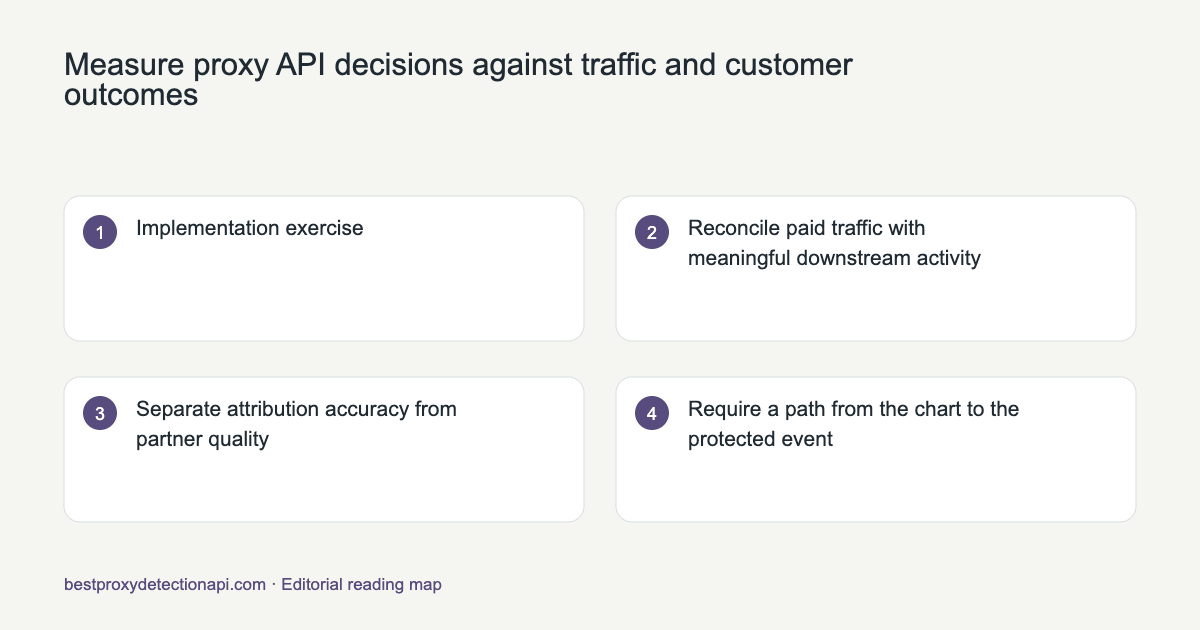
Implementation exercise
Create one event trail containing request reference, timestamp, response category, decision version, applied action and eventual outcome. For an affiliate click, add the partner and qualified conversion reference. For checkout, add approval and later loss. A timeout belongs in an availability report even when the customer succeeds through a fallback. Review legitimate rejections and abandoned challenges, including privacy users on relays. This prevents an implementation from looking accurate simply because it silently drops unscored requests or counts every low-converting campaign as malicious.
Reconcile paid traffic with meaningful downstream activity
A click farm produces coordinated paid or incentivized activity, sometimes using real people and devices. Bot detection alone cannot establish whether a click was purchased in good faith or whether it generated a qualified outcome. Paid-search protection and programmatic impression verification also operate at different points in the ad supply chain.
Use campaign, placement and click references to join arrivals to qualified leads, purchases and retained accounts. Compare patterns across devices, network routes, timing and repeated outcomes. MRC publishes invalid-traffic standards; distinguish general and sophisticated invalid traffic from every low-converting session.
HUMAN offers advertising and application protection families. ShieldLabs scores traffic quality by source, channel, referrer and UTM campaign and can supply visit/account risk. A specialist PPC tool may also manage platform exclusions and refund evidence. Verify which actions are actually supported. A proxy flag, a regional conversion dip or a low dwell time cannot individually prove ad fraud.
Separate attribution accuracy from partner quality
Affiliate fraud can involve cookie stuffing, fabricated leads, bot clicks, misleading promotions or self-generated conversions. A tracking platform records attribution; a fraud workflow tests whether the attributed event qualifies for payment.
Keep click and conversion identifiers, consented attribution evidence, publisher identity, campaign terms and reversals. Reconcile commissions after cancellations or refunds and apply rules to code ownership and influencer campaigns. ads.txt and sellers.json expose parts of the programmatic advertising supply chain; they do not verify every affiliate conversion or publisher claim.
Use device/account links to review repeated applicants and suspicious self-referrals. Compare qualified conversion, approved revenue and retained customers by partner. A partner sending many real but ineligible applications can be low quality without being a bot. When buying an affiliate suite, verify tracking setup, alert latency, regional data handling, review workflow and commission reconciliation separately. Local compliance requirements, including Japanese campaigns, need a documented regional assessment.
Require a path from the chart to the protected event
Fraud analysis software summarizes events and patterns. A decisioning platform also chooses or orchestrates responses, while an investigation system manages cases and evidence. A fraud service may supply people and operations as well as software. Establish which of those responsibilities the purchase includes.
A useful dashboard connects a trend to an event, the signals available at the time, the action applied and the eventual outcome. Add account/device links, policy or model version, review owner and correction history. OWASP logging guidance supports structured security event records and protection of sensitive data.
Public scam trend reporting is different from fraud occurring within your product. A rise in reported scams can be informative without showing that your own customers were affected. For a dashboard builder, specify the source, latency, denominator and drill-down for each metric. A traffic-quality trend alone cannot tell an operator which account should be restricted.
Measure lost legitimate outcomes, including customers who leave
A false decline rejects a legitimate action. Fraud tools, payment issuers, authentication failures and technical outages can all contribute to unsuccessful purchases, so the cause must be tracked. Approved transactions alone cannot reveal how many good customers abandoned after a challenge.
Create a labeled legitimate cohort and join risk result, response, challenge completion, final approval, support contact and later outcome. Compare policies on the same traffic, with a safe review or controlled rollout where appropriate. Segment new customers, mobile users, shared networks, privacy tools and returning customers.
Providers publish incompatible accuracy and conversion claims. A credible comparison needs a common definition, workload and observation window. Tools that expose event history, reason context, reversible responses and outcome feedback make this evaluation easier. Guaranteed approvals can change liability, but their exclusions and costs remain a separate contractual question.
Use voice-specific evidence for caller risk
Caller risk scoring and robocall protection use telephony evidence such as calling-number reputation, signaling, call patterns and identity attestation. A browser device fingerprint does not supply those call records. A phone number that appears on a signup form is also different from an incoming voice call.
RFC 8224 describes authenticated identity for SIP. Attestation helps verify aspects of the calling identity; it does not prove that every conversation is safe or every authenticated caller is trustworthy. A voice-security evaluation should separate unwanted-call detection, spoofing, scam-content analysis and enterprise call-center fraud.
Do not select a robocall vendor from an incomparable accuracy headline. Build a representative call set, check geographic and carrier support, evaluate false blocking and labeling, and inspect how users can challenge errors. Procurement also needs integration with the actual carrier, PBX or contact-center stack and the relevant recording and privacy requirements.
Distinguish detecting a clone from removing it
Brand impersonation monitoring searches for look-alike domains, social profiles, fake apps, counterfeit listings and phishing pages. Takedown is a subsequent platform, registrar, hosting or legal process. A device-risk detector on your own site does not monitor every external copy or remove it.
Build evidence for the asset, impersonated brand, claimed relationship and harmful content. Preserve URLs, timestamps and screenshots through an authorized process, then use the platform's reporting route. Google's legal support workflow illustrates that removal requests depend on the product and reason. Detection volume is different from successful removal and from removal time.
For AI assistants recommending counterfeit sellers, improve authoritative product and seller information, monitor specific answers and report misleading sources through supported channels. There is no general GEO tool that can guarantee recommendations from every assistant. Enterprise buyers should compare coverage of the exact channels, human review, evidence export, escalation and verified takedown outcomes.
Sources
- Mrc official source · read
- Human official source · read
- Shield official source · read
- Adstxt official source · read
- Sellers official source · read
- Logging official source · read
- Refund official source · read
- Ias official source
- Doubleverify official source
- Hype official source · read
- Modash official source · read
- Shieldpricing official source · read
- Adpolice official source · read
- Japan official source · read
- Sift official source · read
- Seon official source · read
- Oscilar official source · read
- Ftcdata official source
- Bbb official source
- Ftcsentinel official source
- Dispute official source · read
- Signifyd official source · read
- Radar official source · read
- Castle official source · read
- Forter official source · read
- Voice official source · read
- Pindrop official source · read
- Hiya official source · read
- Hiyaconsumer official source · read
- Legal official source · read
- Redpoints official source · read
- Bolster official source · read
- Zerofox official source · read
Continue reading
- Proxy api login and bot controls
- Proxy api device and browser evidence
- Proxy api trust freshness and cost
- Proxy api eligibility and repeat accounts
- Proxy api checkout and content access
- Proxy api vendor and adjacent tool selection
- Proxy vpn api response fields
- Proxy detection api latency caching
- Proxy detection api javascript
- Public checkers and vendor demos
- More research guides
FAQ
What signals reveal fraudulent ad traffic?
Repeated device/account patterns, improbable timing, mismatched placements, low-quality downstream outcomes and suspicious networks can support an investigation. Join those observations to campaign records and verified conversions. Treat coordinated human clicks and automated requests separately, and compare sources against their promised outcome rather than only their click volume.
How can a merchant identify which affiliates actually convert?
Join the partner click or referral reference to the qualified purchase, activation or hire and then to refunds and cancellations. Compare approved net outcomes and account-quality evidence by partner. Keep fraud flags separate from poor commercial performance and settle commissions using the documented attribution and qualification rules.
How should display and affiliate traffic-validation tools be compared?
For display/video traffic verification, compare IAS, DoubleVerify and HUMAN using the covered inventory, current MRC measurement scope, general/sophisticated invalid-traffic definitions and report fields. For affiliate conversions, also join partner click/code references to qualified revenue and reversals. The same validation rate cannot represent both impressions and eligible customers. Use one labeled sample and observation window, including false exclusions, to compare accuracy and operational action.
Which tools can assess influencer audience authenticity?
HypeAuditor publishes audience and creator-authenticity analysis; Modash publishes creator discovery, audience analytics and campaign tracking. Evaluate supported networks, audience-quality evidence, freshness and order/code attribution. Their homepages do not establish a verified highest-rated winner. A visitor-fraud API also cannot directly audit the full follower database of an unrelated creator.
Which options should a Japan affiliate program evaluate for cost and alerts?
Consider ShieldLabs for campaign/account traffic-quality evidence with published monthly entry pricing of 99 US dollars for 25,000 identifications, HUMAN for advertising-traffic protection and AdPolice for affiliate/brand-monitoring review. Match each to your attribution and commission ledger. Request supported Japan surfaces, alert timing, required modules and the actual total price; affordable depends on that workload. Follow the Japanese Consumer Affairs Agency disclosure guidance separately, since a fraud alert does not certify advertising-law compliance. ShieldLabs pricing.
Do I need a trend dashboard or a fraud detection tool?
Choose a dashboard to understand a measured trend; choose detection and response capabilities to protect an event. Teams often need both, joined by an event reference and later outcome. Ask who applies the action, how an error is reversed and which evidence is retained for investigation.
Which public tools track scam reports and trends?
Use FTC Explore Data for public dashboards of reported fraud, identity theft and unwanted calls, with category, geography and time views. BBB Scam Tracker offers a searchable public report database and regional heatmap. Treat these as reported incidents and reporting patterns, not a census of every scam or proof of awareness in the whole population. The underlying FTC Consumer Sentinel investigative database is restricted to authorized law enforcement, unlike its public aggregate dashboards.
Which platform has the lowest false decline rate?
No universal ranking follows from public marketing figures. Ask candidates to process the same labeled legitimate and abusive events and report approval, challenge, abandonment and later loss. Confirm which component declined the action and provide an appeal path; otherwise a tool can appear accurate by hiding lost legitimate customers.
Which shortlist helps evaluate false-decline reduction?
For account and device context, consider ShieldLabs, Castle or Sift; for Stripe payment decisions, evaluate Radar; for commerce decisions and contract-dependent protection, consider Signifyd or Forter. Match those roles to the rejecting step, then compare legitimate approval, challenge abandonment, appeal and later loss on the same traffic. Select supported reversible workflows and outcome feedback; a public accuracy headline does not establish the lowest false-decline rate for every business.
Can an IP fraud API replace a robocall protection service?
No. It can add risk context where a digital session is linked to the caller, but voice protection needs supported telephony data and enforcement. Compare caller identity, reputation, carrier coverage, legitimate call completion and false blocking as separate capabilities.
Which voice-fraud services fit different calling environments?
Pindrop Protect addresses contact-center and IVR/agent fraud risk using voice, device, behavioral and spoofing evidence. Hiya operator solutions address network spam/scam protection before pickup and during calls; its consumer spam-blocker app is another product. Choose by carrier/contact-center integration, region, false blocking and correction. These documented roles support a shortlist rather than a universal accuracy winner.
What should an impersonation detection platform demonstrate?
Coverage of the relevant domains, social networks, marketplaces and app stores; a reviewed evidence record; supported reporting workflows; and removal outcomes measured by channel. Ask for the distinction between a detected match, a submitted request and a confirmed removal. A large alert count does not establish effective takedown.
Which vendors belong in an impersonation and takedown shortlist?
Red Points publishes coverage for marketplaces, domains, fake profiles/ads, apps and AI Commerce; Bolster describes domains/typosquats, social accounts, fraudulent ads, marketplace listings and fake apps with takedown workflows; ZeroFox describes external discovery, validation and disruption. Compare actual channel coverage, reviewed evidence, reporting authority, escalation and confirmed removal. Detection or submission is not a guarantee of removal on every platform.
How should counterfeit, fake-app and phishing tools be selected?
Evaluate Red Points, Bolster and ZeroFox against the exact asset: seller listing, app, domain, ad or social profile. Ask for detection provenance, analyst review, supported reporting and verified removal by channel. For AI recommendations, maintain authoritative seller/product information and report specific misleading sources; an AI Commerce label does not guarantee control of every assistant recommendation.