Summarize this page with
A proxy detection API returns information about whether a connection uses a proxy, VPN, Tor exit or another masking service. An IP lookup assesses an address; a browser-assisted integration also observes the current visit. Choose the result your application needs before comparing scores, speed or free request counts.
A registration service and a network investigation tool can both need proxy detection while buying different products. The registration service needs a result tied to the person’s action. The investigation tool may need a provider name, last-seen timestamp or downloadable dataset. Start with that distinction.
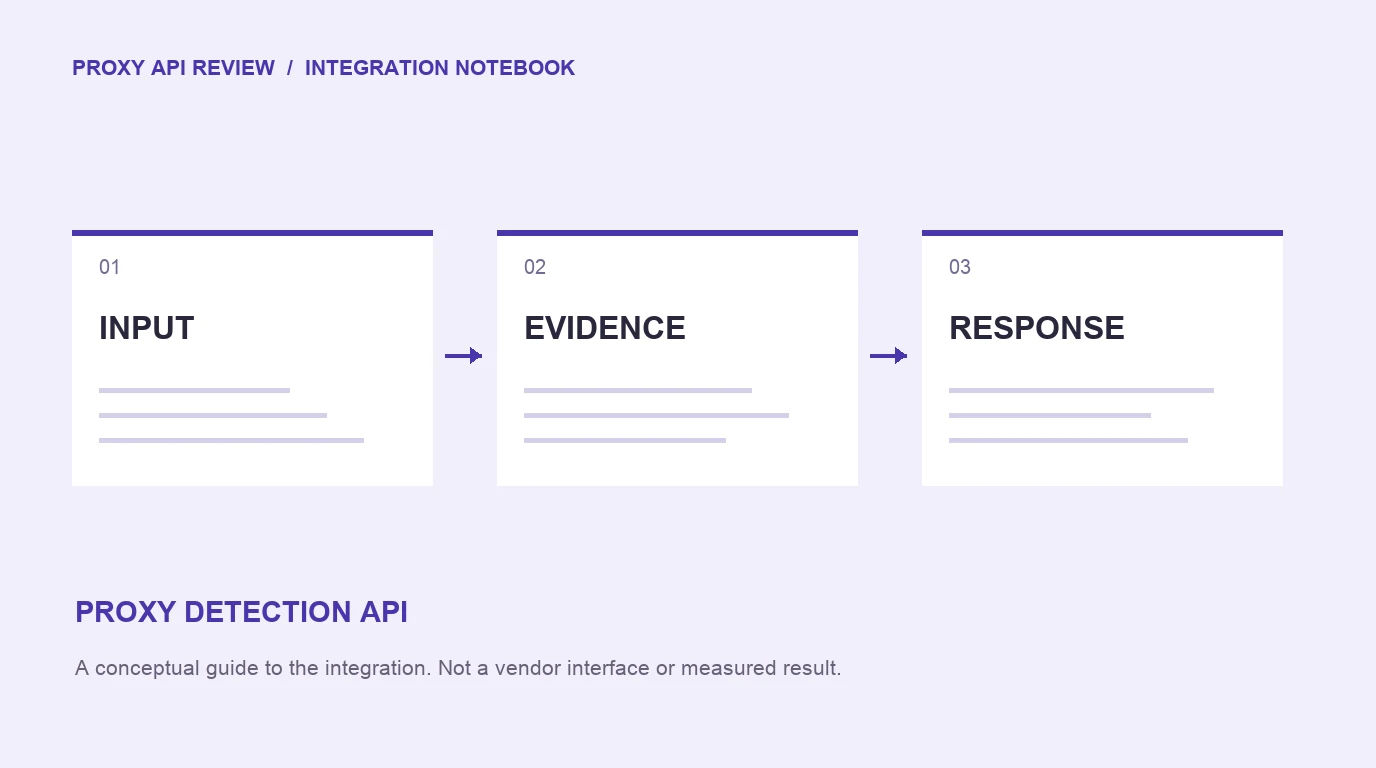
- 1Choose the event
- 2Collect relevant evidence
- 3Read the documented result
Three integration contracts
The main implementation choices are a hosted IP lookup, a local data product and collection in a browser followed by trusted backend delivery. Each has an operational boundary. Adding the word “real-time” to a product name does not make these boundaries interchangeable.
| Model | Input you supply | Result to inspect | Operational work |
|---|---|---|---|
| Hosted IP API | A trusted IPv4 or IPv6 address | Classifications, network context, optional risk or confidence | Authentication, deadlines, errors, quota |
| Local database | An address and a downloaded edition | Fields available in that licensed package | Updating files, checking build dates, distributing editions |
| Browser-assisted collection | A supported browser event | Session/device/network observations and related risk | Client collection, server retrieval, event binding, delivery failures |
ShieldLabs combines current device and network intelligence with identity and account-level abuse detection. That adds context when an aging blocklist has not caught up with a rotating exit. Its integration includes supported collection, API results and webhooks; it should be evaluated in the application flow where the result is needed.
Ipregistry illustrates a structured IP-enrichment contract. MaxMind illustrates why a downloadable anonymizer product and a hosted web service need separate procurement and deployment checks. These are choices about the evidence and interface, alongside the ranking.
Read a classification before acting on it
A hosting address is not automatically a proxy. Hosting describes infrastructure; a proxy classification describes relaying or masking activity. A legitimate remote-work service, monitoring process or cloud-hosted customer can use an address that belongs to a hosting provider.
VPN, Tor, relay and residential-proxy fields also have different meanings. Some may be true together. Do not force the complete result into one exclusive type unless the provider explicitly defines that contract. Keep the original response available for troubleshooting, with an appropriate retention policy.
A fraud score requires its own interpretation. Ask what entity it assesses and what the scale represents. Confidence in a connection classification is not the probability that an account will commit fraud. Our field guide explains how to preserve those differences.
Identify the protected action
Choose a concrete action: creating an account, logging in, claiming a trial or checking out. Write down when the application needs a result and what evidence is available at that point. That determines whether synchronous lookup, collection completed earlier in the flow or asynchronous delivery is appropriate.
For a login check, useful records include the application action ID, account reference, collection or lookup time, provider, response version and result state. Keep credentials and private account data out of client-controlled fields. The JavaScript integration guide covers the trust boundary.
A public checker is useful for seeing a result without building the integration. It does not demonstrate how authenticated delivery, quota handling or retries will work in your product. Use the checker directory to find a suitable first look, then evaluate the documented API or SDK.
What should the first evaluation include?
Use permitted test traffic and label the route independently of the detector. Include legitimate home connections and authorized masking routes, then repeat them after changing one condition. Shared networks and corporate VPNs are useful controls because a restriction applied to those customers can carry a real business cost.
Keep unavailable results separate. An API timeout is not a negative proxy classification; a browser that has not completed collection has not produced a clean session. Record both the detection result and the proportion of actions for which no usable result arrived.
Avoid turning a handful of successful checks into an accuracy claim. Residential-proxy coverage, freshness and false positives need a controlled sample with clear denominators. Use the residential-proxy evaluation guide to plan those comparisons.
Compare access at the field level
Free access can mean identification, a geolocation-only response, signup credits, daily lookup limits or a trial of additional signals. Read the specific entitlement rather than assuming that a free account includes the fields displayed in a public demo.
Our comparison of ten APIs retains the published editorial scores while showing current response and access information. The 42-criterion methodology provides the buying checklist; the free API guide separates quotas and billing units.
The next useful step is small: select one protected action and inspect one real documented response. Record the input, required fields and unavailable states before writing enforcement code.
FAQ
Is proxy detection the same as IP geolocation?
No. Geolocation provides location and network context for an address. Proxy detection assesses relaying or masking. One API may return both, but confirm that the chosen plan includes the required security fields.
Does every API return a fraud score?
No. Some return classifications or confidence values, while others provide an IP, session or visitor risk score. Preserve each scale’s meaning instead of treating every numeric field as interchangeable.
Can I evaluate an API through a public checker?
A checker provides a useful first look at output and scope. A production evaluation also needs the documented integration, field entitlement, error behavior, permitted labeled traffic and a realistic action deadline.
Sources
- ShieldLabs Network Intelligence, live device and network context.
- Ipregistry response fields, structured payloads and unavailable values.
- MaxMind Anonymous Plus, anonymizer confidence and provider context.
- MDN X-Forwarded-For, trust conditions when selecting a client IP.
Continue reading
- Proxy detection API in Python: validation and errors
- Free proxy detection APIs: limits and production cost
Compare all ten tools or read the complete deployment guide.